 Indiiramma Garden
Reduce Fungus Gnats by Managing the Growing Medium
Tiny flies near a pot are a reason to inspect, not enough to name a pest. Look at where they gather, what they look like, and whether the growing media remains wet. Fruit flies, shore flies, and other small insects can be mistaken for fungus gnats.
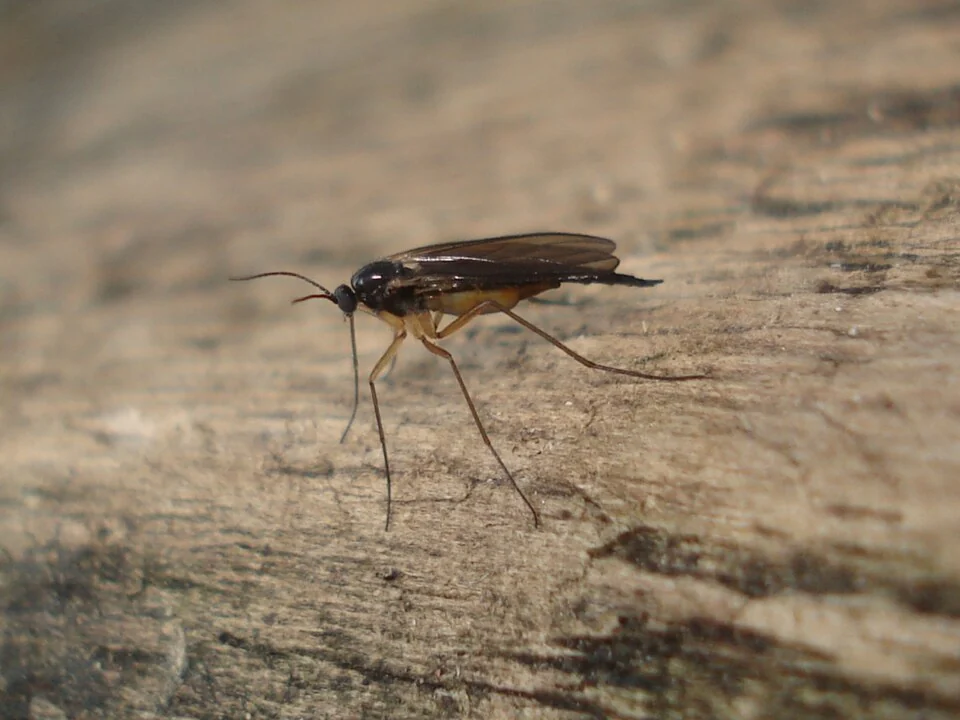
UC Integrated Pest Management describes adult fungus gnats as delicate flies associated with moist growing media. Their larvae live in the media and can damage roots, especially in young plants at high populations; the adults themselves are chiefly a nuisance. UC fungus gnat guide
Find the affected containers
Inspect the surface of each nearby pot rather than blaming the largest plant. Note persistent moisture, decaying material, standing water, and any newly introduced plants or media. Check trays and overlooked containers as well as the one where you first saw a fly.
A yellow sticky card can help monitor adults, but keep its location and date recorded so that later catches mean something. Follow its instructions and place it where it will not contact leaves, pets, or routine hand movements. A collection of unidentified insects is not yet a confirmed diagnosis.
Use a clear close photograph or a specimen when seeking identification. A fly's color alone is not enough, and adults near a window do not prove that every pot is infested.
Change the conditions that support the problem
UC's guidance emphasizes drainage, avoiding excess watering, and removing damp organic debris. Review how you decide to water and where outflow collects. Allowing a suitable surface drying period can be part of management, but do not drive a moisture-sensitive plant into wilt to meet a universal dry-soil rule.
Remove fallen leaves and unnecessary wet debris around containers. Store unused media appropriately and keep its packaging closed. If a particular pot remains saturated, investigate its media and outlet rather than applying a product while leaving the same conditions in place.
Keep confirmed infested plants from becoming a source in another room or grouping. Moving a troublesome pot does not remove the life stages within its media.
Monitor larvae as well as flying adults
Sticky cards show only part of the problem. Continue inspecting growing conditions and plant vigor after adult numbers appear to fall. Do not interpret a quiet afternoon as proof that every life stage has gone.
If cultural changes are insufficient, ask for advice appropriate to the identified pest, plant, and indoor or outdoor setting. A treatment aimed at adults may not address larvae. Any pest product must be labeled for the actual use; this article supplies no pesticide dose, homemade drench, or commercial biological-control rate.
The UC source includes nursery and greenhouse situations as well as homes. Those settings are not interchangeable. A wilting seedling needs a broader root-health assessment, and a gnat observation alone cannot establish why it is declining. No eradication deadline or claim that all tiny flies are harmless is made here.