 Indiiramma Garden
Map the Light Before Choosing Balcony Plants
A bright balcony is not necessarily a sunny planting site. Before choosing crops, find out where direct sunlight actually lands, how long it stays, and what blocks it. A short record of your own space is more useful than a label such as “south-facing” on its own.
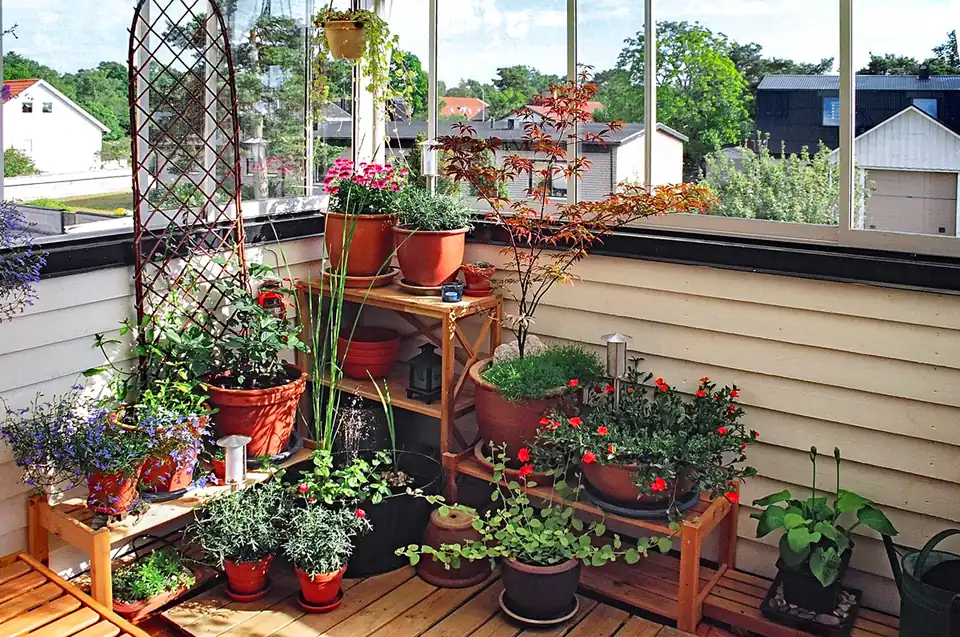
Watch the place where the leaves will be
Choose the locations where containers could realistically stand. Include the height of the eventual foliage: a railing can shade a short seedling while leaving a taller plant exposed. Observe those spots in the morning, around midday, and later in the afternoon. Write down the date, approximate times, and whether light reaches the leaves directly or the area is simply bright.
These observations are a planning aid, not a precision light measurement. A single cloudy day cannot establish the usual pattern. Return on a clearer day, and note interruptions from nearby buildings, an overhang, or a tree. Do not position a pot somewhere impractical just because that spot receives an extra patch of sunlight.
Match the crop to the pattern
University of Maryland Extension distinguishes the stronger sunlight needs of warm-season fruiting vegetables from the lower light requirements of many cool-season leafy crops. Its guidance gives roughly six to eight hours of direct sun for the former and three to five for the latter. Treat those ranges as a crop-selection starting point, not a promise of a particular harvest.
If the usable space has only a short period of direct light, reconsider a demanding fruiting crop before trying to compensate with fertilizer. Check the requirements of the actual plant and cultivar. A productive choice also has to suit local temperatures and the season remaining.
Record heat as well as light
Add a second column for conditions you notice: reflected glare, a hot wall, or a drying breeze. A position can have enough sunlight and still be difficult to manage. If you trial a plant there, check its growing medium and leaves rather than assuming the sun record explains every symptom.
Keep a route to water and inspect the plant. A container placed out of reach is a poor solution even when its exposure looks ideal on paper.
Revisit the map when conditions change
Repeat the observations as the season changes. The sun's path, tree cover, and shadows do not remain fixed through the year. A spring record should not quietly become a claim about midsummer or winter.
Keep the first purchase small enough to adjust. Your useful result is a shortlist of plants for a real location, plus a dated record you can revise—not a permanent label for the whole balcony.
Sources and scope
- University of Maryland Extension, Growing Vegetables in Containers and Salad Tables.
- Colorado State University Extension, Container Gardens.
These US extension sources describe horticultural conditions. The observation sheet is an editorial planning suggestion; no light survey or local growing trial was performed for this article.